The liquidation price of a leveraged position: the inputs, the formula and why margin does not move it.
Ta sekcja nie została jeszcze przetłumaczona na twój język, więc jest wyświetlana po angielsku.
When you trade with leverage, the exchange force-closes your position once the loss eats nearly all the margin you put in. That is liquidation. The liquidation calculator shows the price where it happens and how far the price still has to go.
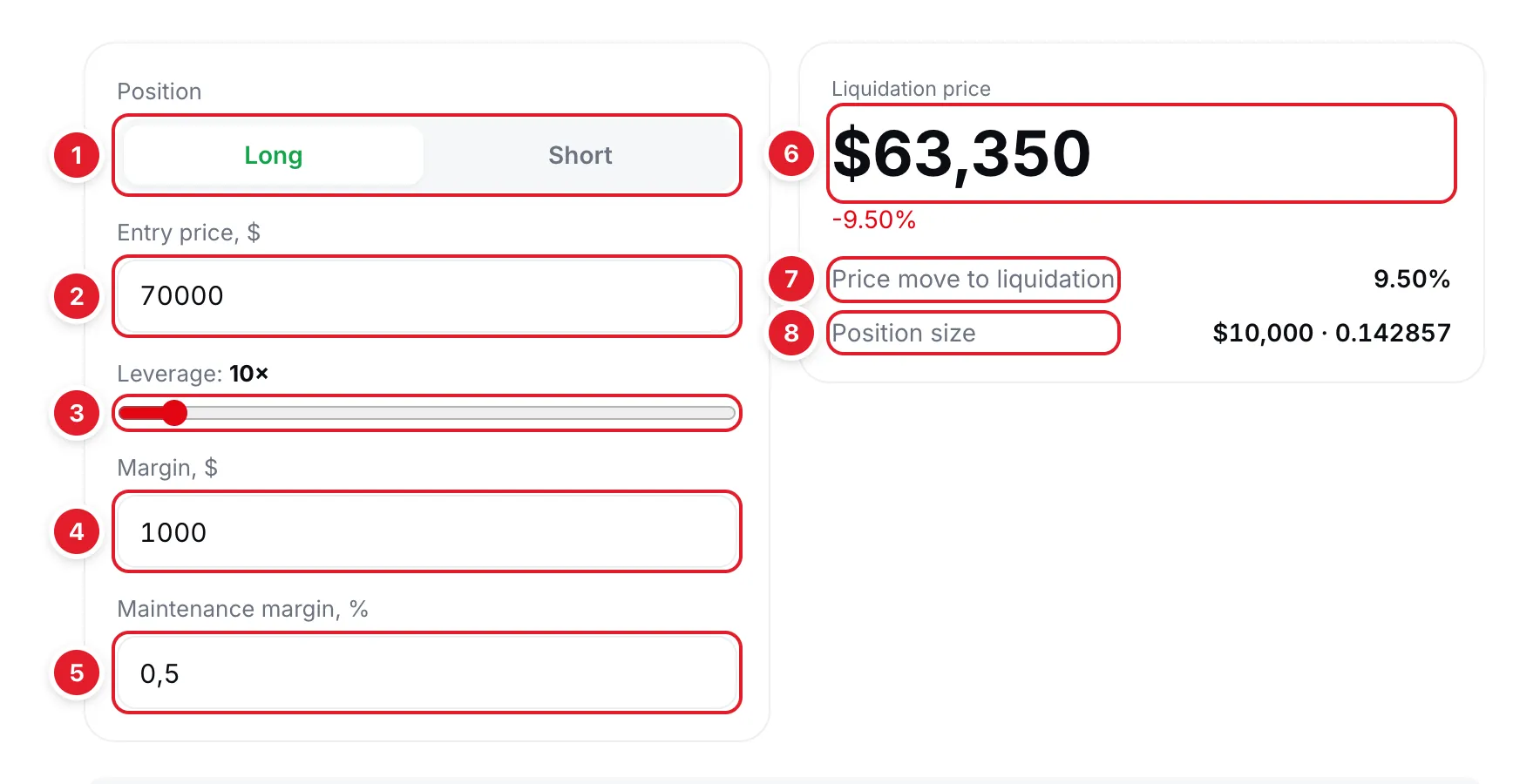
This is for isolated margin. The position is liquidated when the loss reaches the margin minus the maintenance level:
k = 1 ÷ leverage − maintenance margin ÷ 100
long: liquidation price = entry × (1 − k)
short: liquidation price = entry × (1 + k)
move to liquidation = |liquidation price − entry| ÷ entry × 100%
position size = margin × leverage
Example from the screenshot: a long at $70,000, 10× leverage, 0.5% maintenance. k = 0.1 − 0.005 = 0.095, liquidation price = 70,000 × 0.905 = $63,350: a 9.5% drop is enough.
The margin amount only changes the position size, not the liquidation price: that depends on leverage and maintenance margin. If the leverage is too high for the maintenance margin (k ≤ 0, e.g. 125× at 1%), the calculator shows a dash: such a position would be liquidated at once.
The estimate leaves out fees, funding and cross margin, so the real liquidation price on an exchange is usually a little closer to the entry.